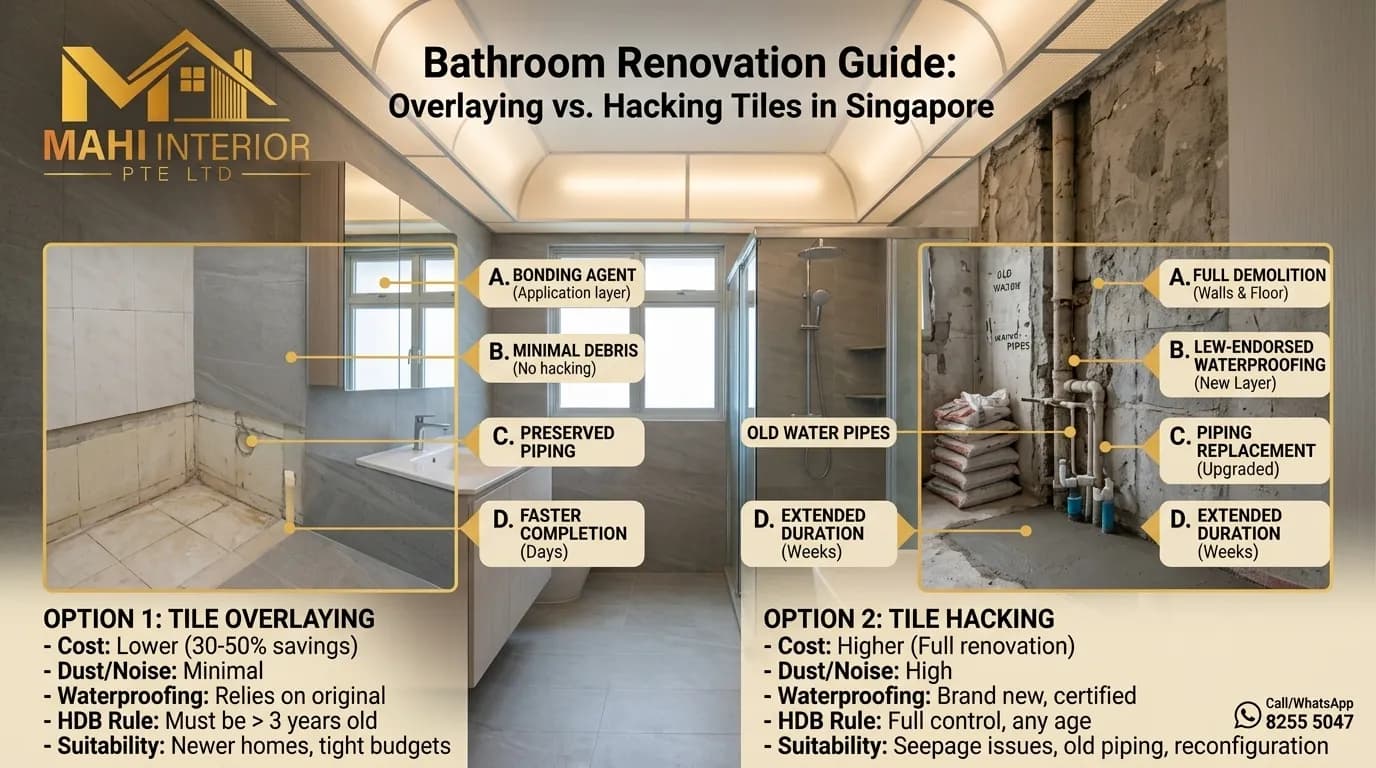
Introduction: Upgrading Your Wet Areas
Bathroom renovations are among the most common home improvement projects in Singapore. Whether updating an aging resale HDB toilet or refreshing a condo bathroom, homeowners must make a key technical decision: tile overlaying or full tile hacking.
In this guide, Mahi Interior evaluates both methods across cost, duration, waterproofing safety, and structural guidelines to help you choose the best approach for your home.
What Is Tile Overlaying?
Tile overlaying involves applying a specialized bonding agent and laying new ceramic or porcelain tiles directly over existing wall and floor tiles without demolishing the original surface underneath.
What Is Full Tile Hacking?
Full tile hacking requires complete demolition of existing tiles down to the raw concrete slab, followed by re-screeding, applying new waterproofing membranes, and laying fresh tiles from scratch.
1. Cost & Budget Comparison
Tile Overlaying
Eliminates demolition labor, debris disposal fees, and heavy masonry preparation, making it significantly more affordable.
Typical cost savings: 30–50% lower labor and material disposal costs compared to full hacking.
Full Tile Hacking
Includes substantial labor costs for hacking, haulage, disposal, re-screeding, double-layer waterproofing, and new tile laying.
Winner: Tile overlaying.
2. Renovation Timeline & Disruption
Tile Overlaying
Fast execution with minimal noise, dust, and structural disturbance to surrounding areas.
Completion time: 2–4 days per bathroom.
Full Tile Hacking
Extensive noisy hacking work, dust generation, and mandatory curing periods for cement screed and waterproofing layers.
Completion time: 10–14 days per bathroom.
Winner: Tile overlaying.
3. Waterproofing & Longevity
Tile Overlaying
Relies on the integrity of the underlying original waterproofing membrane. If the original floor already has concealed leaks, overlaying will not resolve underlying moisture issues.
Full Tile Hacking
Allows complete inspection of structural floor slabs, repair of piping, and application of a fresh multi-layer liquid waterproofing membrane backed by testing.
Winner: Full tile hacking.
4. HDB Regulations & Floor Level Impact
HDB regulations strictly prohibit tile overlaying in new BTO bathrooms within the first 3 years of completion to protect the developer's original waterproofing system. Additionally, overlaying slightly raises the floor level, which requires trimming door bases.
When to Choose Tile Overlaying
- You are renovating a resale HDB (older than 3 years) or private condo on a tight budget
- The existing bathroom shows zero signs of water leakage or hollow tiles
- You need a fast turnaround with minimal disruption
When to Choose Full Tile Hacking
- Your property is over 15–20 years old and due for complete plumbing replacement
- You suspect existing water seepage or water damage
- You want to completely reconfigure toilet bowls, drainage traps, and vanity layouts
Final Thoughts
While tile overlaying offers an economical and speedy makeover, full tile hacking remains the definitive choice for long-term structural reliability and fresh waterproofing peace of mind.
Mahi Interior delivers end-to-end bathroom waterproofing and tile renovation solutions across Singapore. Contact us today for a site inspection and assessment.